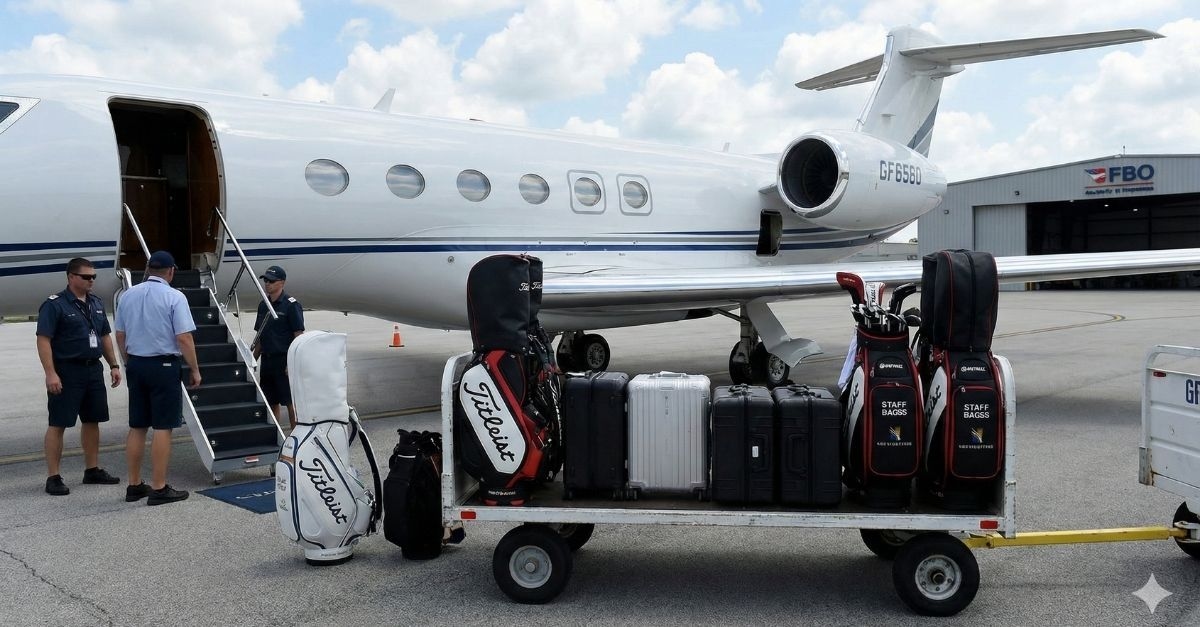
The Geometry of Gear: How to Fly Private with Skis, Clubs, and Bikes Without the Headache
Tuesday, February 17, 2026Dylan AndersonThere is a specific moment of tension that happens on the tarmac, usually right as the SUV trunk pops open. The passengers look at their mountain of hard-shell golf cases. The pilot looks at the sleek, tapered tail of the light jet. And for a split second, everyone does the same mental math: Is this actually going to fit?
The mistake most first-time flyers make is assuming that "luxury" equals "infinite space." In reality, two aircraft can have similar performance specs on paper but behave very differently when you try to load a rigid 190cm ski bag or a Peloton-sized bike case. Here is the practical reality of flying with heavy gear, and how to ensure your luggage arrives on the same aircraft you do.
The Lie of Cubic Feet: Understanding Private Jet Baggage Capacity
If you look at an aircraft brochure, baggage capacity is almost always listed in cubic feet. This is the industry standard, and for the average traveler, it is also a trap. To visualize this, think of a standard large SUV, like a Cadillac Escalade or Chevy Suburban. With the third row of seats folded down, that rear cargo area is roughly 70 to 75 cubic feet. Many light and midsize jets advertise similar numbers, often claiming 60 to 80 cubic feet of space. The logic follows that if your gear fits in the SUV, it will fit in the jet.
Unfortunately, this is where the math fails. Your SUV trunk is a box with square corners and a wide, flat floor, allowing you to stack bags floor-to-ceiling with zero wasted space. A private jet baggage compartment, however, is commonly located in the tail cone of the aircraft.
It is tapered, curving inward like a funnel. If you slide a large, square hard-shell suitcase into that curved compartment, you instantly lose all the space around the edges. 70 cubic feet of technical volume might only offer 50 cubic feet of usable stacking space once you account for the curves.
This is why the shape of the compartment is far more important than the brochure number. A jet with a flat floor and a square door like the Pilatus PC-24 or Phenom 300 will always outperform a larger, awkwardly shaped compartment.
Best Private Jets for Heavy Luggage: Light vs. Heavy Jets
While there are exceptions to every rule, knowing how different classes handle oversized items helps manage expectations.
Light Jets
This is where the geometry gets tricky. Many light jets are fast and efficient, but their tails taper sharply. Hard-sided cases are the enemy here. Because they don't squash, they create "dead air" around them that wastes space.
However, the Embraer Phenom 300 is the gold standard for luggage in this class, offering roughly 76 cubic feet of space. The Cessna Citation CJ4 is also a strong performer. If you are bringing gear on a light jet, these are the models to request.
Super-Midsize Jets
For most golf groups or ski families, this is the target category. Jets like the Challenger 300/350 or the Citation Sovereign are designed with the understanding that passengers come with gear.
The Advantage: You typically get a more rectangular baggage hold. This means you can stack hard cases effectively without fighting the curvature of the aircraft.
Heavy Jets
Once you step up to a Gulfstream or a Global, the conversation changes. These aircraft are built for long-haul, multi-week trips. They can swallow staff bags, multiple ski sets, and nearly anything else you bring.
Flying Private with Golf Clubs: Hard Cases and Staff Bags
Golf clubs are the most common oversized item we see, and they are usually manageable. That's assuming not everyone is bringing their massive, tour-sized bags used by golfers you watch on Tour. They look great, but they are rigid bricks that eat up volume. If you are flying on a Light or Midsize jet, leave the staff bag at home and use a standard stand or cart bag.
Pro Tip: If you are flying with a foursome on a smaller jet, try to enforce a "2 and 2" rule. Two players use hard-shell travel cases (which go on the bottom of the stack), and two players use soft-sided travel covers with stiff arms (which can be squeezed on top). If everyone brings a hard shell, you might run out of room before you run out of weight capacity.
Taking Skis on a Private Jet: Packing for Winter Charters
Skis present a unique logistics challenge because of their length. You might book a jet with a massive baggage compartment volume, but if the bay is only five feet wide, your 185cm powder skis won't fit straight in. They will have to be loaded diagonally, which instantly kills the usable space for the rest of your group's luggage.
Snowboard bags create a different issue. They are often wide and bulky, and when you pack your boots and helmet inside the bag with the board, it becomes a rigid cylinder that is nearly impossible to stack efficiently.
The best way to ensure everything fits is to pack your skis and boards in slim, flat bags, while keeping boots and helmets in separate, soft duffels. This allows the line crew to slide the flat skis along the floor of the compartment and stuff the pliable duffels into the empty corners or around the curved edges of the fuselage.
How to Fly with Bicycles and Oversized Cargo
Bike cases are the ultimate curveball. They are wide, flat, and totally unforgiving. A jet that easily handles four golf bags might fail completely with a single bike box because the door isn't wide enough to slide it in flat.
If you are flying with bikes, never assume. Send us the dimensions of the case and the specific brand. A "soft" Evoc bag fits very differently than a hard-shell Thule box. If you are a serious cyclist, we often recommend the Pilatus PC-12 or PC-24, which feature a massive cargo door originally designed for pallets, allowing bikes to be loaded with ease.
Secure the Right Aircraft for Your Gear
You shouldn't have to measure baggage doors or study fuselage schematics to book a vacation. That is our job. At Just Landed Jets, we don't just look at passenger counts; we look at your gear list. We know which light jets have flat floors, which midsize jets have ski pass-throughs, and which aircraft will leave you stranded on the ramp with a bike case that won't fit.
Don't leave your logistics to chance. Contact Just Landed Jets today, tell us what you are bringing, and let us source the perfect aircraft for your mission.
Read More Latest Updates
Stay informed about private aviation trends, industry news, and travel insights.
Do Private Planes Go Through Customs?
Wondering if private planes go through customs? Learn how private jet passengers clear customs quickly, often right at the FBO, with Just Landed Jets.
Read MoreWhy a Private Jet is the Best Way to Fly with Pets
Fly private with your pet. Just Landed Jets offers pet-friendly private jet charters, eliminating airline restrictions and ensuring an excellent experience flying with pets.
Read MoreWhy Is It Easier to Fly Private With Your Pet?
How does flying private affect your pet? Get vet-backed tips on cabin comfort, calming anxious pets, and prepping your dog or cat for a private jet flight.
Read More